 Midlife Crisis Watches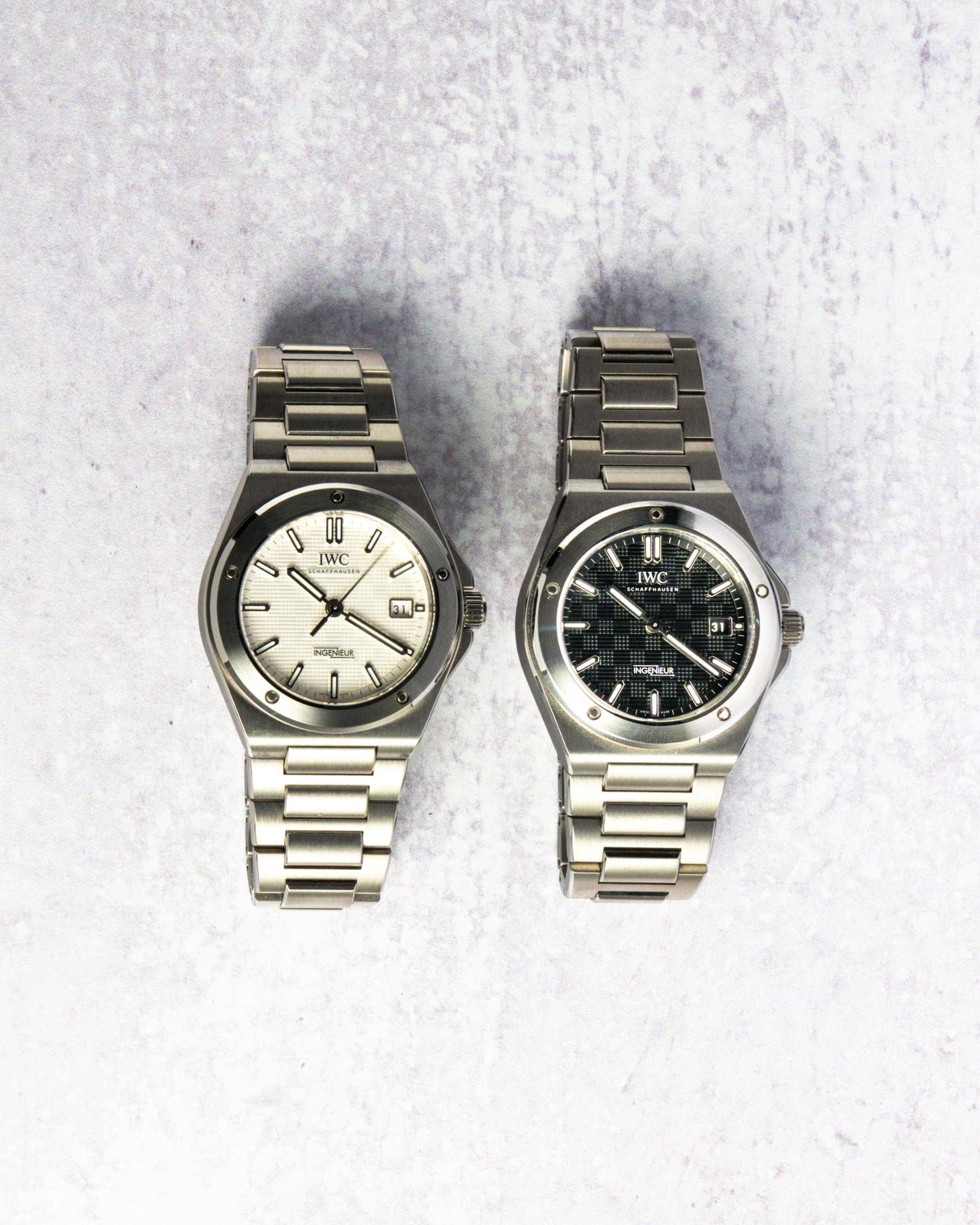
There Are Only Seven Watches
Everything else is a facelift.
By @midlifecrisiswatches · · 8 min readI've owned about 140 watches. I've handled, tried on, or photographed several times that. And somewhere along the way I came to an uncomfortable conclusion: there are only about seven watch designs in the world. Everything else is a derivative and man, there are a lot of homages out there.
That sounds like a hot take. Stay with me, because once you see the seven, you can't unsee them.
One disclaimer before the taxonomy. I'm a collector, not a historian. The origin dates below are the commonly accepted ones, assembled from years of reading rather than archival research, and watch history is contested territory where "first" and "the one everyone copies" are often different watches. If I've mangled or missed a detail, you know how to reach me. The pattern is what I'm confident about. I've seen it across 140 watches of my own and thousands of everyone else's.
The Seven Templates
The dive watch. Blancpain's Fifty Fathoms and the Rolex Submariner both arrived in 1953, and purists will argue about which came first until the heat death of the universe. It doesn't matter. The template everyone copies is the Submariner. Mercedes hands, coin-edge bezel, black dial. I own a 5513, which means I own the master file. Steinhart, Pagani Design, and half of Kickstarter own the photocopies.
The pilot. The Cartier Santos from 1904 is arguably the first purpose-built pilot's watch, though I'll let people with better libraries than mine litigate that. Either way, nobody copies the Santos. They copy the German B-Uhr flieger of the 1940s and the IWC Mark 11 of 1948. Every $400 flieger on the market today is tracing Laco's homework.
The integrated bracelet sports watch. Genta's Royal Oak in 1972, the Nautilus in 1976, with the Laureato and the Vacheron 222 filling out the first wave. This is the most ripped-off template of the last decade. More on this one in a minute, because it's where the whole thesis gets interesting.
The round dress watch. The Patek Calatrava ref. 96, 1932, channeling Bauhaus principles. Nearly every thin, round, small-seconds dress watch descends from it. Even Nomos traces back to the same Bauhaus root through the Stowa Antea of the 1930s.
The shaped watch. The Cartier Tank, designed in 1917, and the Reverso in 1931. My Tortue lives here. Notice how few microbrands do: shaped cases are expensive to execute well, which tells you something about why the other templates get copied so much.
The chronograph. Two templates, really. The Speedmaster from 1957 and the panda-dial Daytona from 1963, with vintage Universal Genève DNA underneath both.
The field watch. The Dirty Dozen spec watches of 1945, carried into the present by the Hamilton Khaki Field. From what I see scrolling release announcements, it's the most copied design in the microbrand space, because it's the cheapest to execute.
That's it. GMTs and worldtimers don't make the list because they're complications wearing one of the seven designs, not designs themselves. Pick any catalog, from Richemont down to the newest Kickstarter, and sort every watch into one of these seven buckets. You'll rarely need an eighth.
The Constraint Isn't Your Wrist
The obvious objection: of course there are only a few designs, a watch is a small round thing strapped to a wrist. Physics did this.
Wrong. The constraint is commercial, not physical. These seven aren't just designs. They're de-risked templates. Decades of marketing have trained buyers to recognize them as "correct," so a brand that builds within a template gets the market's approval for free. A brand that deviates has to earn it from scratch. Microbrands copy the templates because the template does the marketing they can't afford.
My favorite proof of how strong this gravity is, and it's a story I only learned while researching this piece: Jaeger-LeCoultre built the ultra-thin caliber inside the original Royal Oak, the Nautilus, and the Vacheron 222. JLC made the engine for the entire integrated bracelet category. And then it waited more than fifty years to build one for itself, finally launching the Master Control Chronometre at Watches and Wonders this year. (There was a 1973 attempt called the Master Mariner. Nobody cross-shopped it against a Royal Oak. Nobody remembers it.) When the architect of the template eventually has to conform to the template, the template has won.
The BMW Problem
Here's the economic engine underneath all of it. A watch case is like a car platform. BMW pours billions into the architecture underlying the 3, 5, and 7 Series, then amortizes that investment across model lines and multiple generations. In between full redesigns you get facelifts, trim levels, and special editions.
Watches run the identical playbook, just slower. The case is the platform. The dial is the trim level. The limited edition is the M badge. The Submariner hasn't been redesigned in seventy years; it's had facelifts. Collectors call this "icon status." A BMW product planner would call it an exceptionally long platform cycle.
But the analogy breaks in one place, and the break is the most damning part. Cars have an excuse. Crash regulations, emissions, aerodynamics, and pedestrian safety laws genuinely constrain automotive design. Watches have no regulator. Nothing prevents any brand from shipping something radical tomorrow. Which means the sameness is entirely demand-side.
The seven templates persist because we punish deviation. Not physics. Not law. Us.
The Bell Curve, and Where Innovation Actually Sneaks In
Collectors sit on a bell curve. At the leading edge, a small group genuinely wants the new and strange: MB&F, Ressence, Urwerk, the Ulysse Nardin Freak. The fat middle of the curve wants their Subs and Calatravas, and the fat middle pays for everything.
So does innovation ever cross from the edge into the mainstream? Yes, but it takes the service entrance. The exterior stays conservative while the innovation usually ships inside the movement.
The Freak is the perfect case study. The watch itself, with no crown and a movement that rotates as the hour hand, has stayed permanently niche for twenty-five years. But it was, by most accounts, the first wristwatch with silicon escapement components, and that technology went everywhere. Today silicon hairsprings sit inside Tissot PRX Powermatics selling for under a grand. The radical exterior never left the edge of the curve. The radical interior crossed all the way to the mainstream and got cheap doing it.
Same story with co-axial escapements, ceramic bezels, 70-hour power reserves, Spring Drive. We accept enormous change as long as we can't see it.
The one exception that proves the rule: new templates do get born, but only from trauma. The Royal Oak was a radical exterior in 1972 because the quartz crisis left AP nothing to lose. It took a decade to be loved and fifty years to become template number three. Taste doesn't create templates. Crisis does, and hindsight canonizes it.
The Independents Build Their Own Cages
So the real design differentiation lives with the independents and the best microbrands, right? Mostly yes, and for a rational reason: uniqueness is the only asset they have. The big brands sell reassurance. Independents sell distinctiveness. Same industry, opposite products.
But watch what happens next. The independents escape the seven templates and immediately build their own. One case, one movement, and the dial becomes the only variable. Oan.Gio does breathtaking guilloché and Vietnamese lacquer work, on the same case and the same Unitas base. Awake runs gorgeous artistic dials through one platform. Moser sends an endless parade of fumé colors through the Endeavour. Even Laurent Ferrier, a brand I love enough to own twice, treats the Classic case as a platform.
This isn't creative laziness. It's the BMW math again, at smaller scale. Case tooling is the capital-intensive part of watchmaking; dials are marginal-cost creativity. So "differentiation on the edges" turns out to be literal. The edges of the industry differentiate on the cheapest surface to change.
How Many Can You Own?
Which brings this back to the safe, and to the question that drove my cull from 140 watches to 40.
Awake just released a blue and gold dial that is genuinely gorgeous. I'm not buying it. I already own the Moka and the Son Mai. Different colors, same watch. Somewhere around watch 90 of the 140 I finally admitted that I didn't own a collection, I owned a subscription. Every new dial variant felt like a purchase decision, when it was really an auto-renewal I hadn't canceled.
So here's the rule I hold myself to now, and I'd push you to adopt it. Once you own the platform, a new dial is just a color. The next release doesn't have to be different from what you have. It has to be better than what you have. "Gorgeous" doesn't clear that bar. Gorgeous is the minimum price of entry; the brands you love clear it every single release. That's exactly why the rule exists.
Seven templates. One economic force. A bell curve of buyers who claim to want innovation and vote for facelifts. The industry isn't going to change, because we keep telling it not to.
Your safe, on the other hand, is a democracy of one.