 Midlife Crisis Watches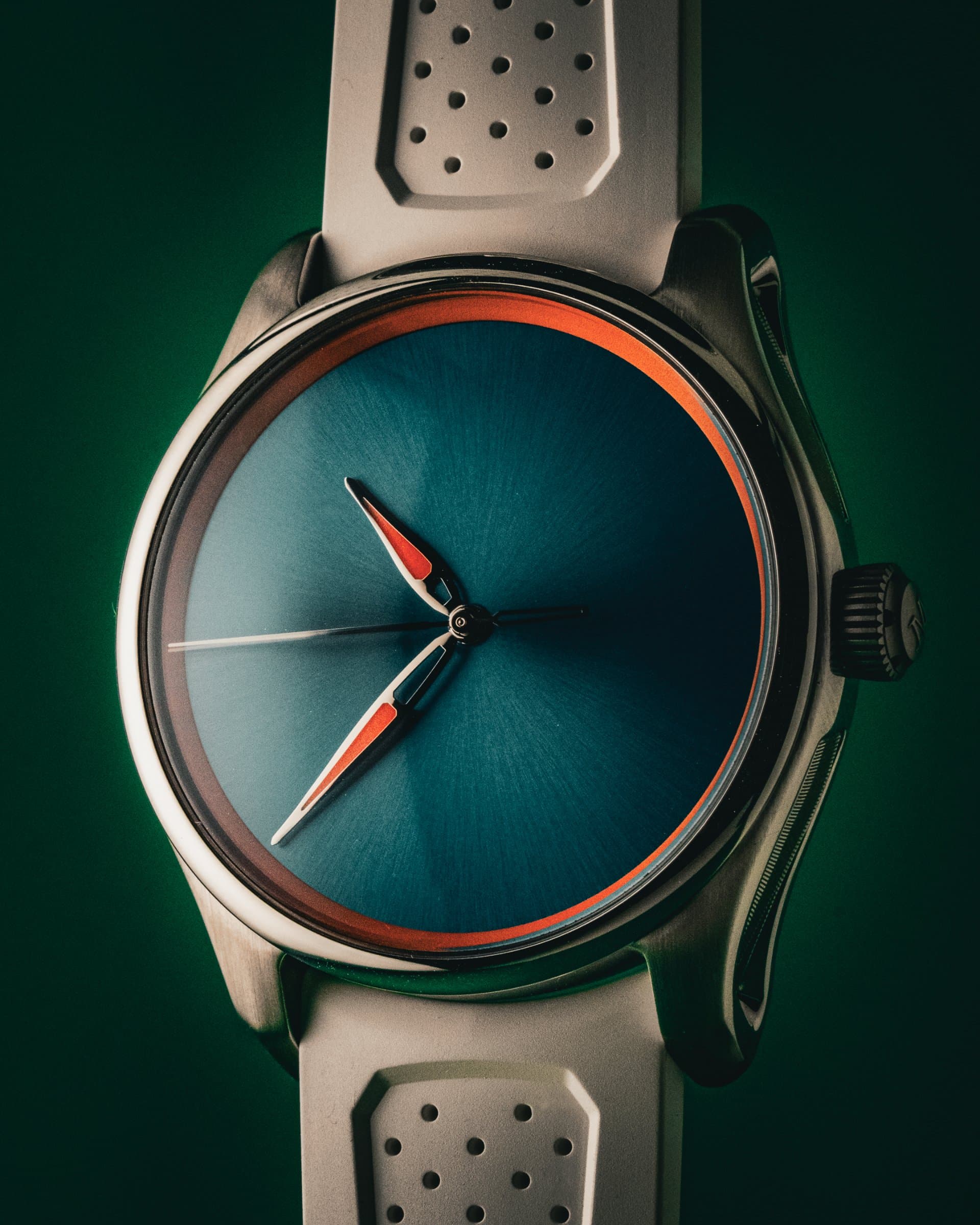
The True Cost of a Watch Is the Price You Get, Not the Price You Paid
On depreciation, letting go, and the $2,000 I didn't expect to spend.
By @midlifecrisiswatches · · 15 min readIn brief. I bought an H. Moser & Cie Spiced Aqua secondhand for $13,500, already well below its roughly $17,600 retail. Three or four months later, I traded it for $11,500. That $2,000 gap sat with me longer than it should have, so I went back and pulled the numbers on every watch I've sold in the last few years. The pattern that showed up wasn't the one I expected.
I've written before about how I buy watches and how I sell them. This one sits underneath both. It's about the number that shows up between the two, and nobody budgets for it because nobody wants to.
The Spiced Aqua is a clean test case because nothing went wrong. I didn't overpay. I didn't get scammed. I bought it secondhand at a real discount to retail, wore it for a season, and traded it into something else. By every reasonable measure, I did this correctly. I still lost $2,000 in under four months. That's roughly $650 a month for the privilege of having it on my wrist, and I didn't see the number coming. If I'm honest, I didn't want to see it coming. I'd told myself a story where a watch bought below retail was already "safe," already priced for the fall. It wasn't. It just meant someone else had absorbed the first hit, and I was there for the second one.
Most watches lose money. That's the base rate, not the exception.
The WatchCharts Overall Market Index, which tracks the 60 most-traded references from the ten biggest brands, has fallen close to 16% over the past two years. No price bracket got spared. Mid-tier brands take it hardest and fastest, entry-level Hublot has been documented losing 40 to 50% of retail value inside the first year.
Even the watches everyone points to as the exception have been sliding, and the retention inside those brands isn't spread evenly either. Patek fell somewhere around 15 to 19% off its 2022 peak. AP dropped a similar amount. Rolex, the steadiest of the three, still gave back 5 to 8% in the most recent full year measured. That's before you get down to individual references, which is where the real story lives. Even at the peak of the market, only around two thirds of Rolex models and roughly the same share of AP models were trading above retail. Patek was closer to half. So a third of the Rolex catalog and a third of AP's were already underwater at the top of the market, and half of everything Patek makes wasn't beating retail even then.
The brand name buys you less than people think. "Buy a Rolex, it holds value" is true for a Submariner or a Daytona and false for a lot of the catalog nobody posts about on Instagram. There are entire spreadsheets floating around the collector community of Rolex references that lose money the second they leave the AD, a diamond DayDate, a two-tone Datejust there, watches nobody's fighting over on the secondary market. What actually protects the resale number is the specific reference and whether real demand exists for that exact configuration. The name on the dial is close to irrelevant on its own.
Moser losing me 15% in a season isn't really the exception to "big three brands hold value." It's the same mechanism, one level down. Moser doesn't have a Daytona-equivalent with a waiting list and a grey market premium. Neither does most of what Rolex, Patek, and AP actually produce.
A car doesn't feel like a betrayal. A watch does.
A new car loses about 20% of its value the moment it leaves the lot, and 60% or more within five years. Nobody feels cheated by that. It's priced in before you sign anything.
Watches don't get the same courtesy in our heads. I think it's because the category is sold on the opposite promise. Nobody markets a car as an heirloom. Watch advertising leans on permanence, on something you're supposed to pass down instead of trade in. So when the market says your watch is worth $2,000 less than you paid, it doesn't register as ordinary depreciation. It registers as a broken promise. The car depreciates. The watch feels like it lied to you.
The mechanism has a name, and it isn't about watches at all.
In 1990, Kahneman, Knetsch, and Thaler ran an experiment that's become one of the most cited findings in behavioral economics. They handed coffee mugs to half a group of students, then asked the owners what they'd sell for and the non-owners what they'd pay. Owners wanted roughly double what buyers offered, for the identical mug. Ownership alone inflated the perceived value.
That's the endowment effect, and it's why letting go of a watch is harder than buying one. The moment something's on your wrist, it stops being a line item and starts being part of how you see yourself. You can't get an objective price on a piece of your own identity, which is exactly why the number a dealer quotes always feels low. The dealer isn't wrong. You were never going to agree with any number that wasn't already the one in your head.
The math nobody shows you.
Every sale breaks down into three numbers, and once you can see them separately, the gap stops feeling personal.
Purchase Price. What you paid.
Buyer Offer. What you're offered when you go to sell or trade.
Delta. Purchase Price minus Buyer Offer. This is what I've been calling the cost of ownership through this whole piece.
Here's the part most people never break apart: the Delta isn't pure depreciation. It's two different things stacked on top of each other, and only one of them is actually about the watch losing value.
The first piece is real market movement, what the watch is genuinely worth today versus what it was worth when you bought it. The second piece is margin, and this is the one people forget exists. Whoever's making you the offer, a dealer, a consignor, a marketplace, isn't a charity. They're taking on inventory risk, tying up cash, doing the marketing, fielding the lowball questions, and eventually finding a buyer. None of that is free, and none of it happens unless there's room in the number for them to make money too. Depending on the channel, that room usually runs somewhere between 10 and 20%, sometimes less if it's a high-volume dealer moving a lot of inventory, sometimes more if it's a slower-moving niche piece they're taking a real chance on.
So the formula looks like this:
Buyer Offer = True Market Value × (1 − Margin%)
Flip it around and you can back into what the market actually thinks your watch is worth, independent of the offer sitting in front of you:
True Market Value = Buyer Offer ÷ (1 − Margin%)
One more layer worth adding, because it's the check that tells you whether a margin is fair or padded. Whoever's giving you the offer isn't just pricing in the chance the watch sits unsold. They're also pricing in the time value of the cash they're tying up to buy it. That's not optional. If a dealer can put the money into a three-month Treasury bill and earn something close to 3.5 to 4% a year risk-free, with zero effort and zero chance of loss, then any offer they make you has to clear that bar first, or they'd be better off just holding cash. The margin isn't just profit. Part of it is what's called the cost of capital, and the floor on that cost of capital is the risk-free rate.
Here's the thing that actually matters for a seller, though: that floor is tiny compared to what dealers actually charge. A 3.5% annual risk-free rate, pro-rated over a typical 90-day hold, works out to less than 1% of the watch's value. That's nowhere close to the 10 to 20% margin most channels build in. Which means the overwhelming majority of that margin isn't compensating anyone for the time value of money at all. It's compensating for the real risk that's specific to watches and doesn't exist in a Treasury bill, the watch might not sell for what they think, the market might move against them while they're holding it, buyers might be harder to find than expected, and unlike a T-bill, there's no guaranteed return at maturity.
That's a useful gut check to carry into any negotiation. If a margin barely clears the risk-free rate, the person buying from you is taking on real risk for almost no compensation, and you're probably getting a genuinely fair offer. If a margin is running well above what riskless capital alone would justify, and there's no good reason for it, that's the signal the number in front of you has more room in it than the situation actually calls for.
Run the Spiced Aqua through all of it. I paid $13,500 and was offered $11,500. If I assume the dealer needed a fairly standard 15% margin to make the trade worth doing, the true market value implied by that offer works out to $11,500 ÷ 0.85, or about $13,530. That's almost exactly what I paid four months earlier. Strip out the roughly 1% of that margin that's just compensation for tying up cash for a season, and the dealer was really pricing in about 14 points of pure risk and effort. That's a real number for taking on a watch that might sit for a while, not evidence the watch itself lost value the way I'd originally told myself.
This is also why the channel you sell through changes the math more than people realize. A trade with a dealer usually carries the fullest margin, because the dealer is taking the watch onto their own balance sheet immediately and needs to protect against it sitting unsold. Consignment usually costs less in real terms, because the commission is disclosed upfront as a flat percentage rather than baked into a lowball number, and you find out exactly what you're paying for the service instead of reverse-engineering it. A private sale to another collector carries close to no built-in margin at all, which is exactly why it nets the most, and exactly why it comes with every headache I wrote about not wanting to deal with in the piece on how I sell.
None of these paths are wrong. They're just different trades between what you keep and what you're willing to do yourself. But once you know the Delta is doing two jobs at once, market movement and someone else's margin, the offer in front of you stops feeling like an insult and starts feeling like a number you can actually take apart.
There's a version of this that's even more common than mine, and it doesn't end in a sale at all.
You decide you're ready to move a watch. You've got a number in your head, call it X. You list it, or you take it to a dealer, and the number that comes back is X minus two, or minus five hundred, whatever the gap happens to be that day. Instead of taking it, you pull the listing. The market's soft right now, you tell yourself, or the buyer didn't know what he was looking at, or you'll try again in a few months once things pick back up. The watch goes back in the box. This has happened to nearly every collector I know, myself included, and it's worth understanding why, because it's barely about the watch or the market at all.
There's a name for this in investing too, the disposition effect, first documented by Shefrin and Statman back in 1985. Investors hold losing stocks far longer than they should and sell winners too early, for the same underlying reason. Selling at a loss forces you to admit the loss actually happened. A stock you haven't sold is just a number that's temporarily down but if you do choose to sell it, then it becomes a recorded loss.
A watch works the same way. As long as it's sitting in the box, the gap between what I paid and what the market says it's worth isn't real yet. It's theoretical. The moment I take the offer, it becomes a fact I have to live with. So the easier move, emotionally, is to just not sell. Keep the watch, keep the story that it's worth what you paid, and let the question go quiet until you've forgotten enough of the number to try again later.
I took the $11,500 on the Spiced Aqua, so that one isn't an example of walking away. But I've done exactly this plenty of other times, listed a piece, gotten a number that felt low, and quietly pulled it rather than deal with what accepting it would actually mean.
My own sales data complicates the story further, and I think it's the more useful part.
I went back through recent sales, upward of 40 watches, instead of trusting my memory of just the one that stung. Two things jumped out that I wasn't expecting.
Limited editions and sold-out microbrands held value noticeably better than the "safe" luxury names did. A Universal Geneve I picked up cheap sold for 145% of what I paid. A Studio Underd0g Steffany Blue, sold out from the brand, netted 120%. A Sinn 556 with the mother-of-pearl dial went for 104%. A Christopher Ward C65 in Aeolian Bronze came back at 94%. Compare that to the Spiced Aqua's 85% retention over a much shorter hold, from a brand with real Swiss pedigree behind it. The pattern held across the board, not just in a couple of lucky sales. Scarcity and genuine demand for a specific reference beat brand reputation almost every time in my own numbers. That tracks with something Tony Traina has written about, that the current market rewards real, provable scarcity over brand prestige alone, and punishes anything the market suspects was overproduced without the collector base to back it up.
I also underestimate my own upside almost as often as I overestimate it, and the direction depends on whether I have an anchor. Every watch in my spreadsheet has an "estimated hold" column, my own guess at resale before it sells. On pieces where I had a clean retail number to compare against, I tended to expect too much and get disappointed, the Moser being the clearest case. On a few vintage pieces I bought secondhand with no real MSRP to reference, I badly underpriced my own expectations instead. A vintage JLC I picked up with, in my own notes, "no idea on price," I guessed would fetch around $280. It sold for $1,450.
The pain isn't really about depreciation itself. It's about the gap between an anchored expectation and reality. Give me a retail number to compare against, and I'll overvalue what I'm holding. Give me nothing to compare against, and I'm just as likely to undervalue it. Either way, the surprise comes from having a fixed number in my head at all, not from the watch doing anything unusual.
King Flum wrote something years ago on ScrewDownCrown called "Do You Miss Depreciation," about how watching a watch's value fall used to just be part of the deal, before the market convinced everyone new watches were supposed to go up. He's onto something. Depreciation isn't a malfunction. It's what happens by default, and the last several years of Rolex and Patek headlines just made us forget that for a while.
Which brings me to the reframe that actually helped.
I stopped asking what I lost on the Spiced Aqua and started asking what it cost me to wear it. Same $2,000, different question. "What did I lose" assumes I was investing and the investment failed. "What did it cost me to wear it" assumes I was renting an experience, and the bill came due when I gave it back. Under that frame, $650 a month for a watch I wanted on my wrist most weekends isn't a loss at all. It's closer to what I'd pay for a nice bag or a good coat I never expected to appreciate, except I got to enjoy this one the whole time and still recovered most of what I paid.
I don't think that reframe removes the sting entirely, and I don't think it's supposed to. But it changes the question I'm asking myself the moment a number comes back lower than I hoped. The honest question was never "is this a fair price." It was always "what did I actually pay to own this, all in, and was it worth that." Most of the time, if I'm being straight with myself, the answer is yes. I just wasn't asking the right question until the spreadsheet made me.