
The Missing Middle: Why Luxury Is Leaving the Middle Behind (Part 1)
Zenith, Porsche and Ferrari show why the $10,000 watch is running out of room
By @midlifecrisiswatches · · 15 min readTwo Zeniths
I own two Zeniths. They sit a foot apart in my watch box, and after last month they sit on opposite sides of the company's strategy.
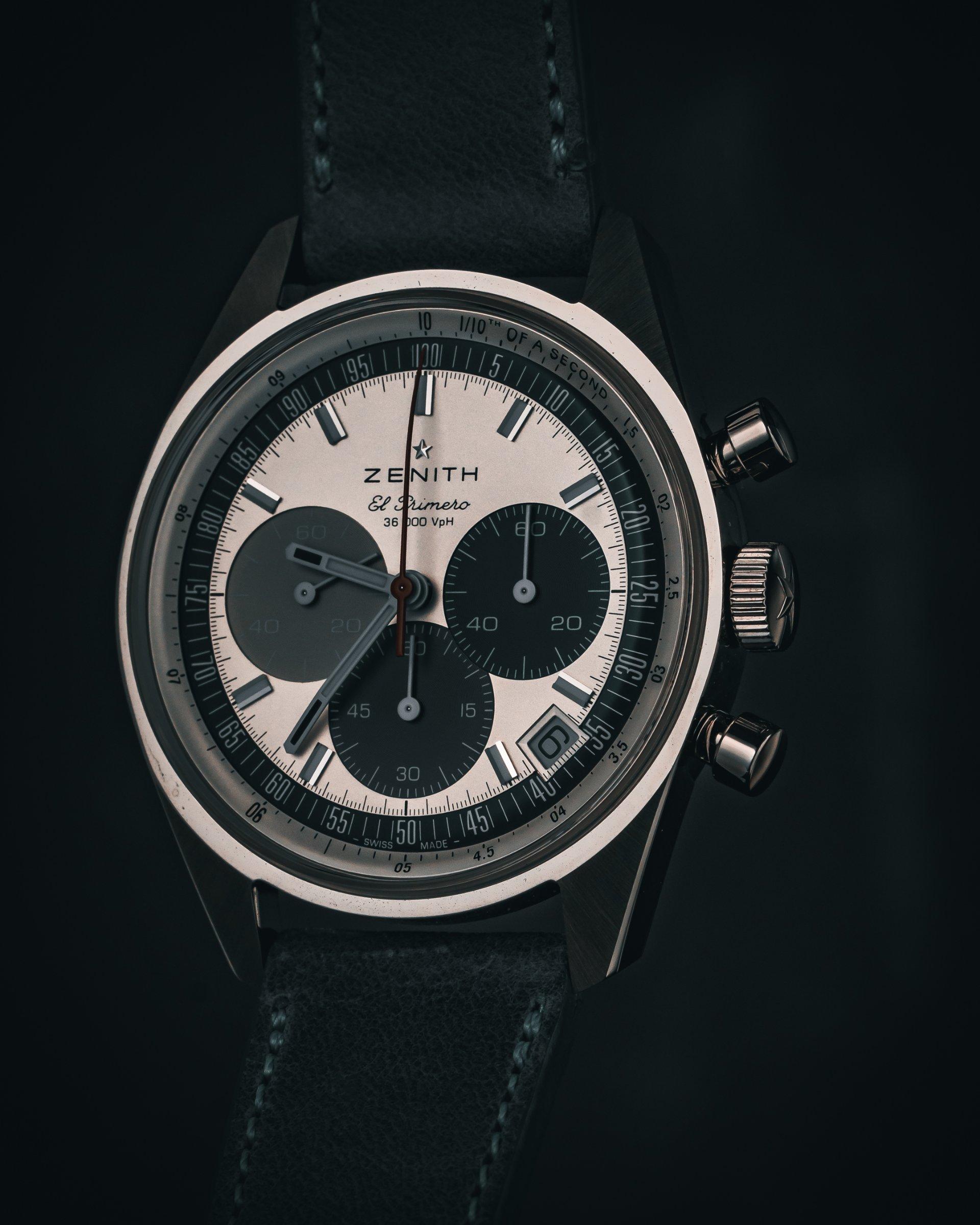
The first is a Chronomaster Original steel case, El Primero movement, and a price a disciplined collector can get to. It's the Zenith most people picture.
The second is a G.F.J. Bloodstone in yellow gold. It's made in small numbers, finished to a much higher standard and priced accordingly. When I traded into it, it felt like it came from a different company.
In a way it did. On October 22, Zenith told staff it was opening a consultation on a "strategic repositioning," and that one sentence was the entire official statement. The rest came from people close to the company, who told Reuters that up to half the Swiss workforce could go and the brand would refocus on high-end watches and complex movements. Sources speaking to Hodinkee Japan went further and said production of core lines, the Chronomaster among them, may end. Zenith hasn't confirmed that. The repositioning is due to wrap up by 2029.
I don't know whether the Chronomaster name survives. Zenith could keep it and move it up in price. What I do know is that my Chronomaster sits in the price band Zenith says it's leaving, and my G.F.J. sits where Zenith says it's going. That's what we are going to dive into with this post.
Zenith isn't the only one making this move. Universal Genève came back this year at prices most of its old fans can't reach, and Gallet came back at the other end of the ladder. Porsche just told investors it wants to sell fewer, more expensive cars.
This piece is a pricing primer that uses watches and luxury as the case study, along with a look at the economy pushing brands in this direction. Part 2 will get into what it means for collectors.
BTW, I'm not an economist but I am an investor. I work in finance. I have zero inside information that has gone into this piece and I know nothing more than anything I can publicly research.
Everyone is leaving the middle
Four companies made big pricing moves this year.
Zenith is going up. A brand that built its modern identity on steel El Primero chronographs is restructuring to become a high-end maker. The signs were there before the announcement. In June, Zenith released a G.F.J. co-signed with Naoya Hida, ten pieces at about $75,000 each.
Universal Genève came back above. Breitling relaunched UG in April with the Polerouter starting at CHF 14,000, and the cheapest steel versions list at $16,100 in the US. That pricing was planned from the start. When Breitling bought UG in 2023, CEO Georges Kern said it would be much more expensive than Breitling, whose average watch then sold for about CHF 6,700. For comparison, a 1960s Polerouter De Luxe in rose gold was recently listed at $8,950, and a new Polerouter Date in rose gold lists at $30,475, more than three times as much.
Gallet came back below. Same owner, but opposite direction. Gallet relaunched in September at $2,900 for the time-only Flying Officer, $4,400 for the chronographs on strap and $6,700 at the top of the range. When Breitling announced the deal in 2025, Kern acknowledged that Breitling's average price had risen sharply. Bilanz described Gallet as the answer for shoppers who leave Breitling empty-handed because it costs too much.
Porsche is going up on purpose. On October 7, CEO Michael Leiters laid out a plan called Sportwagenschmiede '35. Its headline number has the average price of Porsche's top models rising from about €270,000 to more than €330,000 by the end of the decade. The company wants to break even below 200,000 cars a year, after delivering 279,449 in 2025, down 10%. Leiters said he wants to elevate Porsche's positioning, protect its exclusivity and gain pricing power. A UBS analyst put it more simply, saying Porsche is replicating what Ferrari does.
You can see it in the base 911, which started at $98,750 in 2020. The cheapest 2026 911 you can configure is $137,850. I wish I would have hung onto my previous 911s.
Every one of these moves went away from the band Zenith is leaving, roughly CHF 8,000 to 15,000. Gallet sits below it. Universal Genève starts at its very top and runs up to CHF 320,000. Zenith and Porsche are both heading higher.
The Ferrari template
Porsche and Zenith are both following a business that has already shown the approach works: Ferrari.
Ferrari sold 7,255 cars in 2014, the year before it went public, and 13,640 in 2025. Volume grew slowly, by design. What grew faster was how much Ferrari makes on each car.
2019 | 2025 | Change | |
|---|---|---|---|
Cars shipped | 10,131 | 13,640 | +35% |
Net revenue per car | €371,700 | €523,900 | +41% |
Net profit per car | €69,000 | €117,300 | +70% |
Sources: Ferrari FY2019 and FY2025 results. Per-car figures are total revenue and net profit divided by cars shipped, so they include parts, sponsorship and other income.
This year shows it even more clearly. In the first half of 2026, Ferrari shipped 6,802 cars, down from 7,087. Revenue still rose about 8% at constant currency, and Ferrari raised its full-year guidance on stronger personalization than it expected. CEO Benedetto Vigna says the order book entirely covers 2027.
Ferrari sells fewer cars than people want and makes more on each one. Two parts of how it does that carry over to watches.
It builds fewer cars than it could sell. That's my read of an order book that runs through 2027. The wait protects resale values, strong resale values make buyers comfortable paying full price, and full price protects the brand. Zenith's CEO said nearly the same thing in his first month on the job in 2024: if the market wants 100, I want to produce 99. He had the right philosophy at the wrong price point.
Personalization works as a second price ladder. On top of the sticker price, Ferrari sells paint, leather, carbon and special configurations. On its July earnings call, management said personalization ran above 20% of cars-and-spare-parts revenue. It's price discrimination that customers enjoy. Two buyers of the same model can pay very different amounts, and the one paying more is glad to, because the car is different from everyone else's.
The result is an operating margin near 30%. Porsche's was 1.1% in 2025, so it isn't hard to see why its new CEO picked Ferrari as the role model.
Pricing 101
Five ideas explain most of what's above.
1. Price is a signal. For most products, raising the price means fewer buyers. Luxury stops working that way past a certain point, because the price becomes part of what you're buying. It tells you, and anyone who sees your wrist, that the object is rare and serious. Economists call these Veblen goods. If you raise the price of a toaster, you sell fewer toasters. If you raise the price of a 911, you can sell the same number to people who want it more.
2. The ladder matters more than any one rung. Brands price in steps: an entry piece to get you in the door, a middle piece where most buyers land, and a halo piece that makes the rest look reasonable. Universal Genève's range runs from about CHF 14,000 for a steel Polerouter to CHF 320,000 at the top, and part of the reason the top exists is to make CHF 14,000 feel sensible.
3. Raising prices faster than inflation is repositioning. Matching inflation protects a margin. Running at four times inflation means you've chosen a different customer. Chanel's medium Classic Flap cost $5,800 in 2019 and costs $11,700 today, up 102%, while US consumer prices rose about 26% over 2019 to 2025. Costs don't explain that gap. My read is that Chanel decided it wanted to sit next to Hermès.
Chanel had company. RBC estimated in 2024 that major luxury companies had raised prices 33% on average since 2019, and that price drove half their recent growth. McKinsey's number is bigger: from 2019 to 2023, price increases accounted for more than 80% of luxury growth. Volume barely moved, so the industry grew mostly by charging more to roughly the same people.
4. List price is what the brand hopes. Clearing price is what the watch is worth. I wrote about this in The True Cost of a Watch Is the Price You Get, Not the Price You Paid, and it applies here too. I bought an H. Moser Spiced Aqua secondhand for $13,500, against a retail price of about $17,600, and sold it three or four months later for $11,500. That watch sits squarely in the middle, and the secondary market had repriced it well before Moser did.
5. Scarcity is a choice. Nobody runs out of steel. A brand that makes fewer watches than it could sell has decided to, and that decision holds up the price. The middle has trouble here because its business model depends on making more.
A note on reading watch statistics. The Federation of the Swiss Watch Industry reports exports in price bands, and those are export prices, not retail. Retail runs roughly two to three times higher, per trade press estimates. When the FH says watches above CHF 3,000 fell 8.1% in January while the CHF 500 to 3,000 band grew 17.7%, the upper band starts at a retail price of roughly CHF 6,000 to 9,000, which is about where Zenith's range begins.
The middle is a fixed-cost trap
The usual explanation for the shrinking middle is that its buyers went away. That's part of it. The bigger problem is the cost structure.
Each end of the market has its own way to win. The low end wins on scale, because enough volume turns a thin margin into a real business. The high end wins on margin, because a few hundred watches at $50,000 don't need volume behind them.
The middle carries the machinery of scale without either advantage. It has a manufacture to run, retail to staff, boutiques, marketing budgets and a sales team in every region. Those costs stay put whether it sells 20,000 watches or 12,000.
So when demand dips, sales fall, the costs don't, and margin goes quickly. The low end can cut prices and lean on volume, and the high end can sell fewer pieces without much damage. The middle doesn't have a lever like either one.
Zenith shows how this plays out. Its core range sits between CHF 8,000 and 15,000, per Le Temps as relayed by AFP, and that's the segment it plans to leave. Morgan Stanley estimates Zenith's sales fell from about CHF 138 million in 2023 to about CHF 98 million in 2025, per Revolution. A source quoted in the Swiss press called the cuts a question of survival, and SJX noted that Zenith's manufacturing base is oversized for what it now sells.
CEO Benoit de Clerck told staff the market had changed for good and wasn't going through a temporary air pocket.
A factory can't be shrunk into a boutique, so Zenith is cutting the business down to what the high end can support and keeping the factory busy by supplying movements to its LVMH sister brands. The middle turns out to be a business model as much as a price point, and that model only works while volume is growing.
The K, honestly framed
Most people have heard of the K-shaped economy, where the top arm rises and the bottom arm falls. The statistic everyone quotes is that the top 10% of earners now drive half of US consumer spending.
That figure is softer than the headlines suggest. Moody's Analytics put the top 10% share at 49.2% in mid-2025, the highest since its data begins in 1989. Then Moody's changed its method to account for taxes, and the 2025 figure became 45.8%. A revision that large should make anyone cautious about the exact number.
The government's survey comes out much lower. The BLS Consumer Expenditure Survey puts the top 10% at about 23% of spending in 2024. The Minneapolis Fed reviewed the evidence in March and concluded the available data don't line up into a clear K-shaped story. The real share is somewhere between 23% and 46%, which is a wide range for a number usually quoted as settled.
Where the K shows up clearly is in wealth and in recent spending growth, and both matter for luxury.
Wealth. As of mid-2026, the top 10% of US households held about 69% of household net worth and about 88% of stocks and mutual funds, per the Fed's distributional accounts. Stocks have had a strong few years, and when your watch budget comes out of a brokerage account, a strong market works like a raise.
Recent growth. The New York Fed tracked retail spending by income and found recent growth has been driven by high-income households. The gap opened in 2023, after pandemic support ran out, and lower-income spending didn't get back to its early-2023 level until mid-2024.
At the bottom of the wage ladder, people are treading water. In the year to September, wages for the lowest-paid quartile of workers grew about 3.4% while consumer prices rose 3.7%, which is flat to slightly negative in real terms.
That matters for pricing. A brand selling a $7,000 watch is selling to the household most exposed to the K, with a good income, not much of a portfolio and aspirations by definition. When that buyer's real income stalls, the $7,000 watch can wait. The buyer of a $70,000 watch is spending stock gains and barely notices.
The K doesn't have to be as dramatic as the headline for this to hold. It's enough that the people at the top keep pulling away in wealth, and they are.
The Breitling barbell
Breitling's three brands make more sense as one portfolio than as three separate stories.
Gallet sits below: $2,900 to $6,700.
Breitling sits in the middle, with an average price of about CHF 6,700 when it bought UG.
Universal Genève sits above: from CHF 14,000 for a Polerouter, up to CHF 320,000.
Georges Kern left Breitling where it was and built a barbell around it.
Gallet is there for the buyer who walks out of a Breitling boutique over price. Universal Genève is there for the buyer who has outgrown Breitling and wants something quieter and rarer. Kern told Monochrome in 2024 that UG would have zero overlap with Breitling in positioning, so each brand is aimed at a different arm of the K, on purpose.
A holding company can do this and a single brand can't. Zenith had one name and one price band, so when the middle got squeezed it had to leave. Breitling can keep its middle brand and add exposure at both ends, with UG for a top that keeps pulling away and Gallet for an aspirational buyer who trades down.
Private equity readers will recognize the move. Partners Group agreed to take a majority stake in Breitling in 2022, and this is how an investor handles a structural shift in a market: build a portfolio that wins whichever way it breaks.
Price is only power when you control supply
Raising prices isn't the answer on its own. The luxury industry spent five years doing exactly that and ran into a wall in 2025, when UBS found luxury prices rose only 3% from January to May 2025, the slowest pace since 2019. Charging more to the same people works until those people notice.
The brands still winning pair price with scarcity. Ferrari keeps supply behind demand and has an order book through 2027, which is why its price increases stick. A brand that raises prices while its boutiques sit full of inventory is mostly hoping the customer won't notice.
That's the test for Zenith and Porsche. Printing a bigger number on the tag is easy. Building the craft, the scarcity and the waiting list that make the number believable takes years. Porsche has the 911 and a lot of factory capacity to shrink, and Zenith has the G.F.J., a Naoya Hida collaboration and until 2029.
Back to my watch box... The Chronomaster is a great watch at a price plenty of people can reach, and in Zenith's new plan that's the problem. The G.F.J. is harder to make and harder to get, which is what makes its price easy to defend.
Part 2 looks at where value goes once the middle empties out. My short answer is relationships: independent makers, souscriptions and pieces made for one person. It's the watch world's version of Ferrari personalization, built on very different economics.