 Midlife Crisis Watches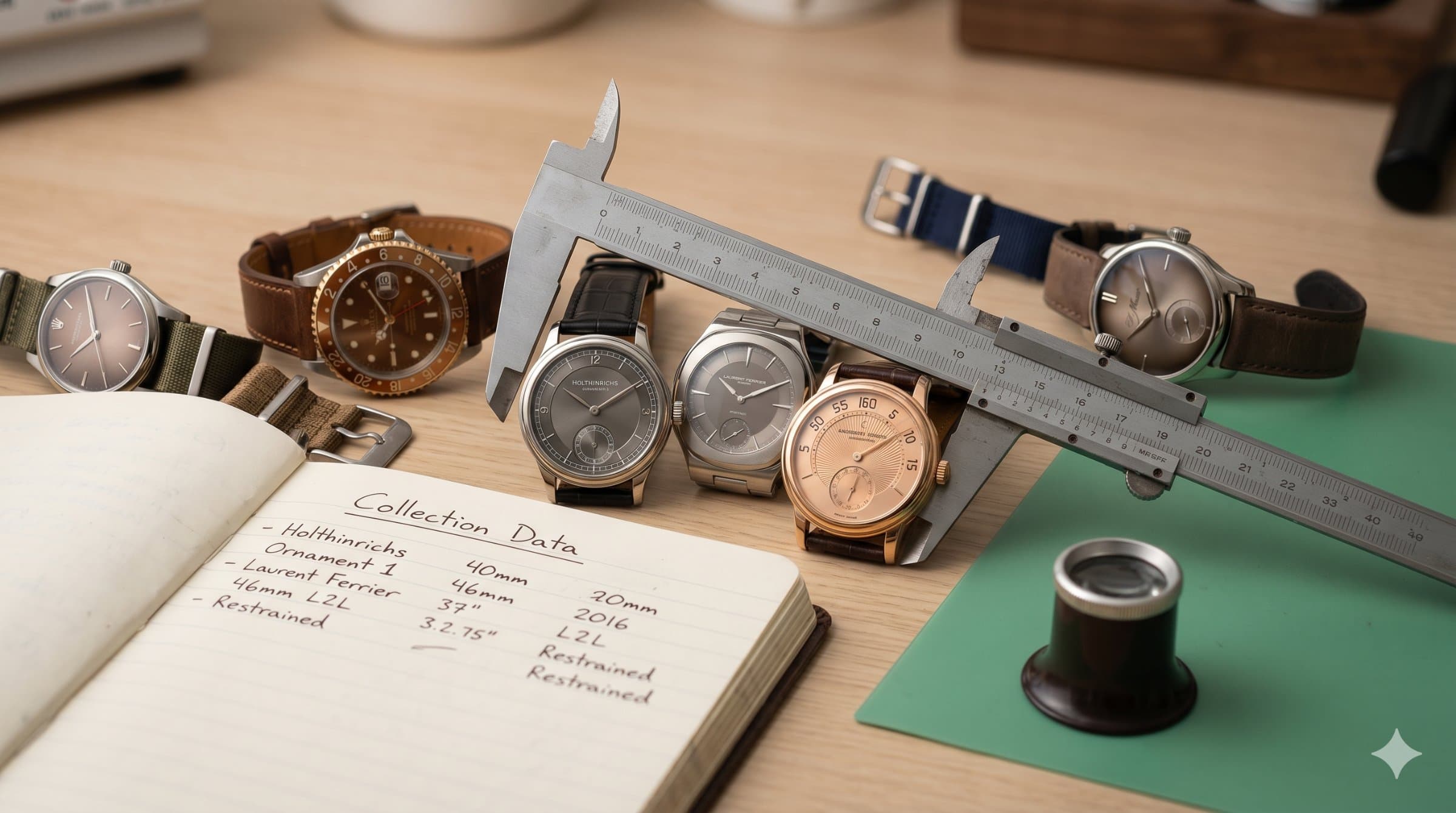
What My Watch Measurements Say About Me
Diameter, lug-to-lug, weight: the numbers reveal a thesis I never set out to have.
By @midlifecrisiswatches · · 5 min readI measured twelve of my most-worn watches the other day. How do I know they are most worn? I am a nut and track every watch I wear. Diameter, lug-to-lug, weight. The patterns in the data started to reveal something I hadn't fully articulated about how I collect.
I didn't set out to build a collection with a thesis about these attributes. What I discovered is that I’m fairly consistent with the watches that get wrist time.
The 40mm Thing
Eight of my twelve most worn watches are at or very near 40mm in diameter. The others cluster in the 38-42mm range. There are no outliers. No 36mm minimalists. No 44mm sports watches.
I didn't consciously decide to collect 40mm watches. But looking at the data, it's obvious I've gravitated toward this size repeatedly. Why?
40mm is the intersection of presence and practicality. It's substantial enough that you can actually see the dial. It’s small enough to wear under a dress shirt cuff. It doesn't dominate your wrist. It sits there like it comfortably belongs.
A lot of watch writing treats size as a matter of personal wrist circumference. Find your wrist size, find your case diameter. But I think it's more subtle than that. Size is also about how you want to experience the watch. Do you want to feel it on your wrist, or do you want to see it on your wrist? I'm in both camps these days.
For those curious, my wrist size is just under 18cm these days.
Lug-to-Lug: The Forgotten Spec
A watch mentor told me that lug-to-lug matters more than diameter. It's how the watch sits on your wrist as it's the distance from the top of one lug to the bottom of the other. A 40mm watch with 45mm L2L wears totally different from a 40mm watch with 50mm L2L.
My watches cluster tightly around 45-48mm. Most fall in the 45-47mm range. This wasn't intentional. But it means that despite variations in case size and material, my watches all wear fairly similarly.
The Dial Problem
I have exactly one watch with a truly bold dial color. The vintage Rolex Rootbeer 16713. Brown dial, copper and yellow bezel. It's the only piece in my collection that announces itself.
Everything else is restrained. Silvers, greys, blues. Some dial textures that catch light differently depending on the angle, but nothing that shouts. The H. Moser is white gold with a brown dial, which sounds warm until you realize the brown is so muted it reads almost graphite under most lighting.
I own a Zenith with a gorgeous lapis lazuli blue dial. A Laurent Ferrier with a striking deep blue dial. These are not boring watches. But compared to a lot of watch dial options out there, they're understated.
The Rootbeer is the exception that proves the rule. Looking at my collection objectively, I clearly prefer restraint. So when I bought the Rootbeer with its insistent brown and gold accents, I made a conscious choice to break my own pattern. That interests me. It suggests that even as someone who collects with restraint, I needed one piece that didn't follow the code. Candidly, now I need to find more occasions to wear it.
Precious Metals as Function, Not Status
Four of my watches have precious metal components. The H. Moser is white gold. The Rolex Rootbeer has Everose gold accents. The Rolex Yachtmaster has a platinum bezel. The Cartier Tortue is a hunk of white gold.
The white gold Moser pairs with its muted brown dial in a way that feels right. Yellow gold would be wrong. The Everose gold on the Rootbeer is warm, almost orange, which works with that brown dial and multi-color bezel. The platinum bezel on the Yachtmaster doesn't announce itself at all. Platinum is so dense and rare that its value is invisible. You don't see the platinum doing anything. It just adds presence and weight.
In every case, I chose the precious metal because it served the design, not because I wanted people to know it was precious. That distinction matters.
Complications You Have to Know About
I own several watches with serious complications. A world timer. A perpetual calendar with moonphase. Two chronographs. A GMT.
But none of them are loud about it. The Glashuette PanoMaticLunar has its moon phase off to the side in its asymmetrical way. The Nomos Worldtimer doesn't impose its function on the dial. The Laurent Ferrier SportAuto is a sports watch, but a refined one.
This might be the clearest signal in my data. I don't collect complications for the sake of having complications. I don't want a watch that says "look how much I spent on a moon phase." I want mechanical complexity. I want to know how to use it. I just don't want it to dominate how the watch looks.
What This Actually Means
If I had to summarize what my measurements reveal, it's this. I collect watches that are optimized for wearing and looking. Not for flex. Not for catching light in a way that announces luxury.
I've built a collection that's philosophically coherent even though it spans independent watchmakers and Rolex, white gold and stainless steel, dress watches and sports watches. The coherence isn't about price or prestige. It's about restraint. It's about preferring a watch you have to wear to truly appreciate.