 Midlife Crisis Watches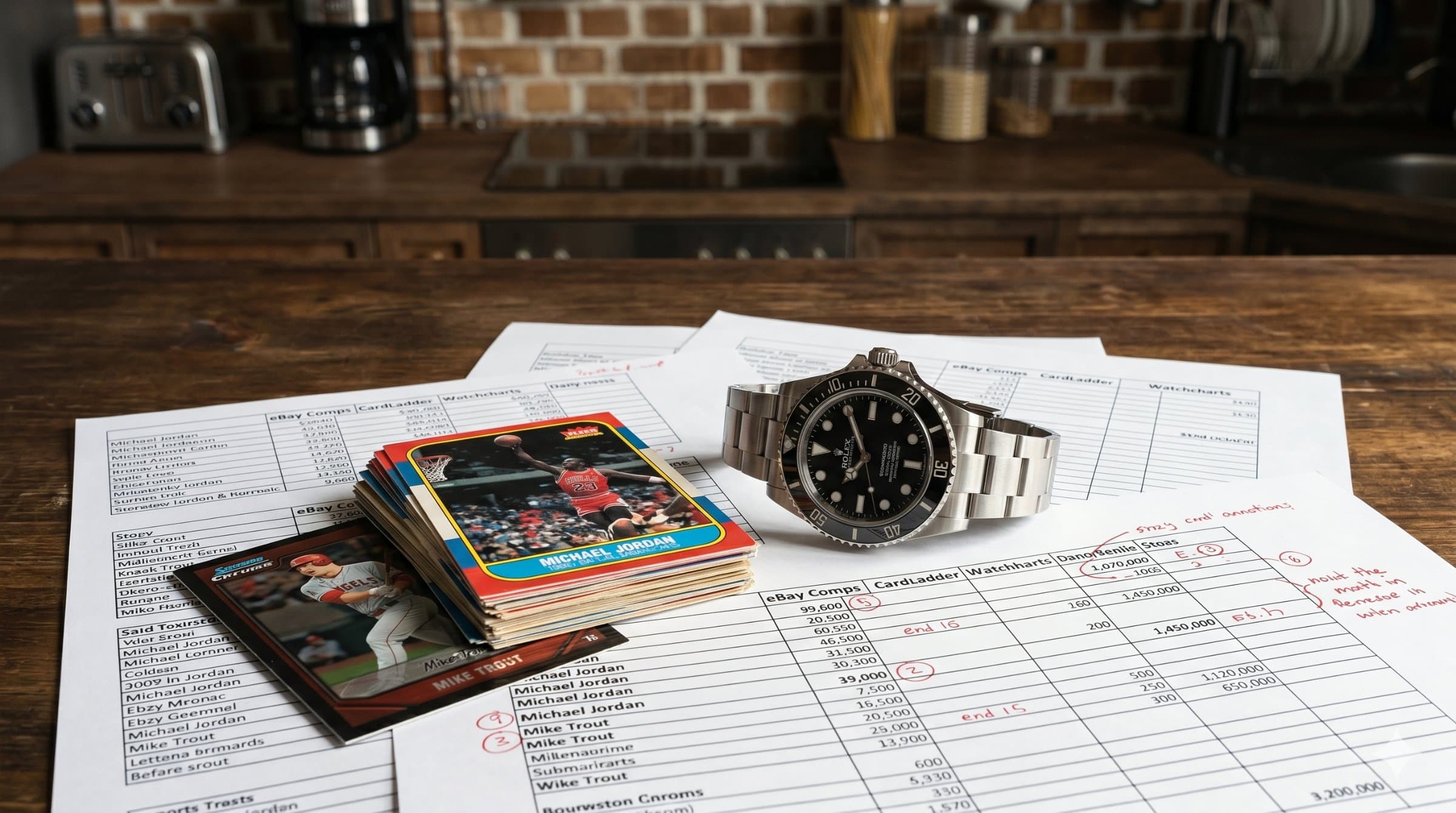
Watches Are Terrible Investments. Buy Them Anyway.
A friendly response to @NYCWatchGuy's bull case, with sports cards and a 1996 Cartier auction as evidence.
By @midlifecrisiswatches · · 9 min readOnce upon a time, I ran an Instagram account called @midlifecrisiscards. About 900 sports cards, organized in a Google Sheet, photographed at my kitchen table, with comps I tracked obsessively on eBay, CardLadder and PWCC. Today I also run @midlifecrisiswatches. The kitchen table is the same. The Google Sheet still exists. Only the object on it has changed.
The lens has not.
Back in May 2020, I wrote a piece called "What Yeezy, Topps Chrome, and Supreme Have Taught Us." The whole argument was three words. Scarcity breeds wantedness. Five years later, my friend @NYCWatchGuy just published "The Bull Case for Watches" on Medium, and it is the same argument applied to a new object. He is right about more than people will give him credit for. He is also missing two things, both of which I learned the hard way in cards, and one of which Tony Traina just published the receipts on at Unpolished.
Let me try to put it all together.
What @NYCWatchGuy gets right
His central claim is that we are still early in the process of moving the watch market from a niche collector world into a global cultural-asset world. The two-audience model of the past (the deep nerds and the rich-guy flexers) has expanded to three. The internet did not just make watches easier to buy, it made them social at global scale. The high end is supply-constrained in a way that maps cleanly onto art-market dynamics. And the wealth pool keeps growing while the supply of important objects does not.
All true. I lived this in cards.
In September 2020, at what felt like the absolute peak of the COVID-era card mania, I wrote that the sports card market was at an all-time high and walked through why. Stimulus checks. Time at home. GaryVee. eBay maturing. New comfort with alt assets. Sports gambling adjacency. The market was end-to-end digital. The community had moved to Instagram, YouTube Live, Loupe, WhatNot, Twitch, Discord, and fifty Facebook groups. The infrastructure that used to gate the hobby (Beckett magazine in the mailbox, the Westchester County Center card show on weekends) had been replaced by a 24/7 global feed of comps, breaks, razzes, pulls, and grading turnaround data.
That is the watch market in 2026. Phillips livestreams. Watchcharts comps. Bezel and Hodinkee secondary listings. Instagram dealers DMing trade offers across three continents. Watch Twitter pricing in real time. The Westchester County Center exhibitions still exist (yes, they really do), but the price discovery happens in the cloud.
@NYCWatchGuy's "what inning are we in?" question has a sports cards answer. We are in roughly the same inning watches sit in now that cards sat in during late 2020. End-to-end digital. Active makers beating institutional references. Global buyer pool stepping in. Which brings me to the moment that should make every watch collector sit up straight.
The Mike Trout moment, now with a French accent
In my September 2020 piece, I flagged that a 2009 Mike Trout Bowman Chrome SuperFractor had just sold for $3.84M. The previous high-water mark in the card market was the Honus Wagner T206 at $3.12M. An active player, in his 20s, on his rookie card, had just blown past the legendary vintage reference.
In May 2026, an Akrivia AK-06 sold for roughly $3.8M. It is a hand-finished contemporary tourbillon by a living independent watchmaker named Rexhep Rexhepi. Retail was $83,000. The sale price was roughly 30x retail and 5.6x the last AK-06 auction result from 2023.
This is the watch market's Mike Trout moment. An active maker, mid-career, blowing past the auction comps that used to be reserved for important Pateks. @NYCWatchGuy is right that this is a signal of asset-class formation. I am also pretty sure I have seen this movie before, and I remember how it ended.
What @NYCWatchGuy is missing, part one: markets work in cycles
Here is the line from my September 2020 piece, written at what we now know was within months of the absolute top:
"Markets work in cycles and expect there to be some pullback in the next year or two. The transient money will run, and prices will come down a bit. Those are critical buying times within the market, and I look forward to that."
I was right, and not because I am a genius. I was right because every collectible market I have studied does the same thing. Cards corrected hard between 2022 and 2023. Modern (the speculative middle of the market) dropped 50% to 80%. Vintage mostly held. The trophies mostly held. The middle got carved out.
This is the part @NYCWatchGuy's piece does not address. He treats the up arrow as continuous. It is not.
If you are buying an established Schelling point (a Newman Daytona, a Tiffany Nautilus, a Crash) and you can hold for 20 years, you are probably fine. If you are buying a third-tier independent at 25x retail in 2026 because someone on watch Instagram compared it to a Rexhep, you are not buying the bull case. You are buying the speculation overlay on top of the bull case. Those are different trades with different outcomes.
The speculative middle is where the pain lives. That was true in cards. It will be true in watches.
What @NYCWatchGuy is missing, part two: the math doesn't actually work
This is the part where I want to send everyone to Tony Traina's piece at Unpolished, which just published the kind of receipts the watch community usually pretends do not exist.
Tony pulled the 1996 Antiquorum Magical Art of Cartier auction catalog and compared 1996 sale prices to 2026 sale prices on the same references, 30 years apart. The data:
Platinum Tank Guichet (one of three made specifically for that auction): $40k in 1996 → $452k in 2026. 11x return.
London Asymetrique: $32k → $751k. 23.5x.
1991 Paris Crash, limited to 400: $26k → $450k. 17.3x.
Stock 1970s Tank Louis (ref. 78086): $5,600 → $10,000. 1.7x nominal. A real-terms loss after inflation.
The S&P 500 returned 18x over the same window.
Read those numbers slowly. A custom Cartier commissioned for the most important Cartier thematic auction ever held returned 11x against an 18x index. The Paris Crash, one of the most coveted watches on the planet right now, returned 17x. The Tank Louis (the watch that every nice middle-aged guy in America has been told "holds its value") lost money in real terms over 30 years.
If you think the Akrivia at 30x retail in 2026 is going to materially outperform a passive S&P index over the next 30 years, you are betting against a data set that just embarrassed the entire watch-as-investment thesis.
I am not saying do not buy watches. I am saying stop pretending it is an investment trade. The math has rarely worked, even on the trophies, even when you nailed the asset-class call.
The Uncanny Valley is where the real money was
Tony's piece has one more move worth stealing. The actual over-performers in his 1996-to-2026 data were not the trophies. They were the watches nobody wanted in 1996.
The 1986 London Crash PASSED at the 1996 auction. Low estimate of $20k. It sold last month at Sotheby's for $2M. That is a 100x return.
The Tank Allongée PASSED in 1996. Sold last month at Sotheby's for $727k. 36x.
These were not the celebrated lots. They were the awkward, recently-discontinued, weird-shape, "not yet collectible" pieces the room walked past on the way to the Patek-signed 1436 split-second chronograph (which sold for $240k in 1996 and has not made similar headlines since).
Tony calls this the Uncanny Valley of Collectibility. The window between "recently discontinued" and "officially recognized as important."
Cards had the exact same dynamic. The biggest gainers over the last 15 years were not the 1952 Mantles. Those were already trophies in 1996. The gainers were the pre-rookie Bowman Chrome cards of players nobody yet knew would become first-ballot Hall of Famers, and the weird refractor parallels from the late 90s that nobody collected because parallels were not yet a category. A 2009 Trout Bowman Chrome was a $20 card when it was issued. The Superfractor sold for $3.84M in 2020.
If you must think about watches as a trade, the only frame that has historically produced alpha is the unloved, the recently discontinued, and the not-yet-recognized. The London Crashes of 1996. The references current Instagram does not understand yet. The independent watchmakers who exist but do not yet have a $3.8M auction comp.
By definition, you cannot identify these in advance with high confidence. That is why it is a lottery ticket, not an asset class. Worth playing if it is also a watch you genuinely want to own. Not worth playing as a financial trade.
So what does this mean
Three lenses on the same market.
@NYCWatchGuy: the bull case is real because culture, wealth, internet, and scarcity. Watches are becoming a global asset class.
Me, from cards: yes, AND that asset-class transition runs through speculation cycles that crush the middle of the market. I called the correction in 2020 and it landed in 2022 and 2023. Watches will get their version.
Tony: yes, AND even the trophies usually underperform a passive index over 30-year windows. The actual outperformance lived in the watches nobody wanted at the time.
These three lenses do not contradict each other. They are the same picture from three angles. The honest synthesis is that the bull case is structurally correct AND the bull case is not an investment thesis AND the parts of the bull case that do produce returns are almost impossible to identify in advance.
Which leaves exactly one rational frame (in my mind) for buying watches.
Buy what you love.
The watch you would wear at half the price is the one you should own. The watch you would only want at twice the price is not a watch, it is a position. Positions get unwound.
I learned this with cards by buying everything in 2020. The market corrected. I figured out which pieces in the collection I still wanted after the prices stopped doing the talking. The ones I wanted were the ones that meant something to me. The ones I had bought as trades were dead weight.
I am applying that lesson to the watch box now. So is @NYCWatchGuy, even if his piece reads slightly more bullish than mine. Tony is too. We are all basically saying the same thing in three different keys.
The hobby is good and the community is real. Cycles come. The math has rarely worked, and that is not going to change.
Buy what you love.
How much time you got?
Darren MLCW