 Midlife Crisis Watches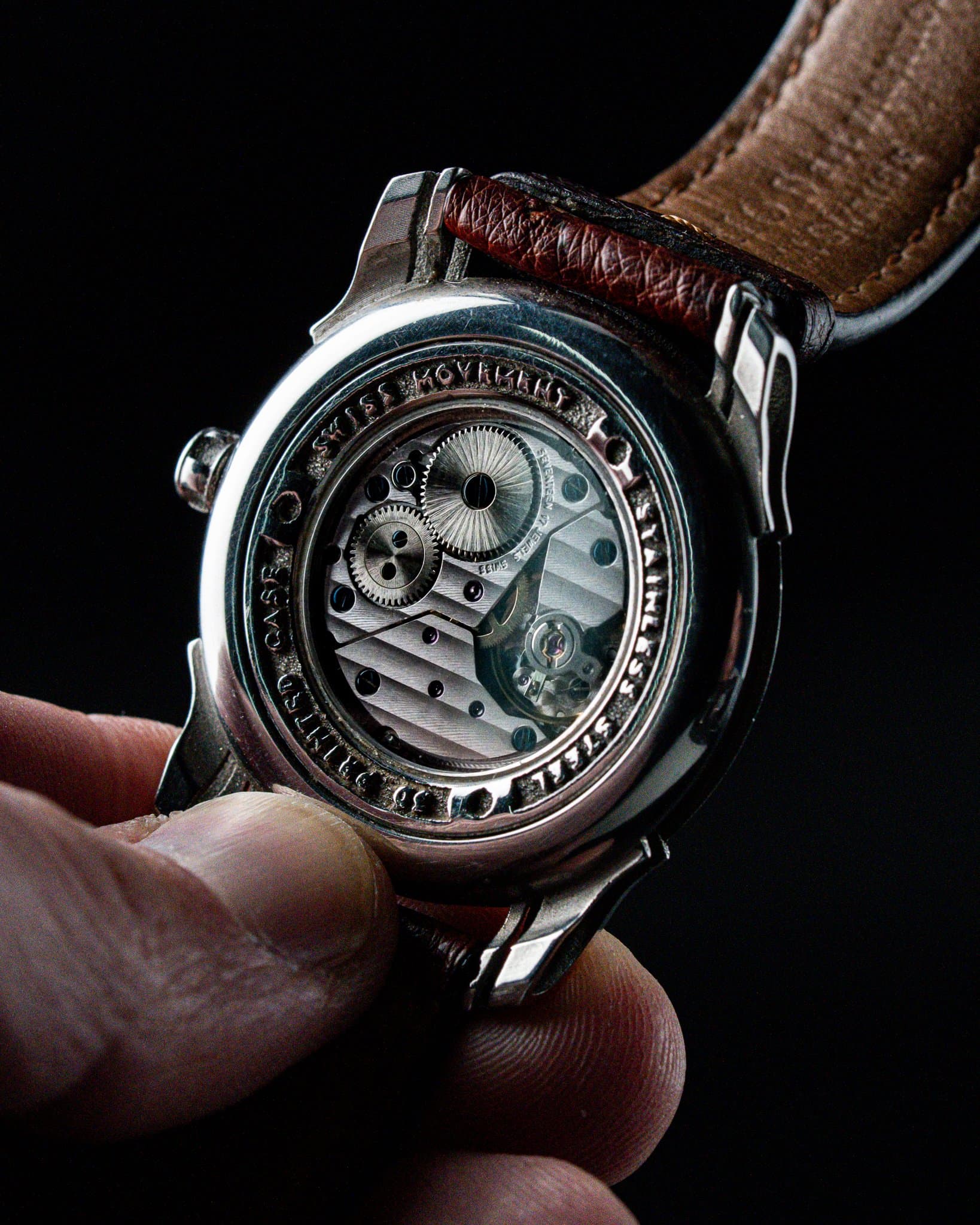
3D Printing Isn't Killing the Watchmaker's Hand. It's Moving It.
Can a 3D Printed Watch Ever Be as Impressive as a Hand Made One? Inside Holthinrichs, MING, and the Future of Watchmaking
By @midlifecrisiswatches · · 10 min readI watched a video last week of a guy designing and machining his own watch parts, and it sent me down a rabbit hole I haven't climbed out of since. The channel is small, the production values are basic, and none of that matters. What matters is the question underneath it: how much of a watch can actually be printed rather than made, and what happens to the industry, and to us as collectors, once the answer is "most of it"?
This isn't science fiction anymore. It's already happening at the top of the independent scene, just not evenly, and not where most people expect.
Where the technology actually stands
Holthinrichs, the Dutch independent out of Delft, has been 3D printing titanium cases since their first watch, the Ornament 1. Last year they pushed further with the Deconstructed, which pairs a printed titanium case with a fully printed titanium bracelet. Skeletonized, alien-looking, and remarkably light: 51 grams with the bracelet on, 20 grams without. They call their whole aesthetic philosophy Horlogerie Brut, which is really just a fancy way of saying they leave the texture of the printing process visible instead of polishing it away.
MING went a different direction entirely with the Polymesh. It's 1,693 individual titanium components, printed as one continuous closed loop, no pins, no screws, and the gaps between the links are so tight they're basically invisible to the eye. MING has been direct about what this actually means: the bracelet cannot be made by traditional machining. Not "is harder to make" or "is more expensive to make." Cannot. Printing didn't just make something cheaper here. It made something new possible.
So the case and the bracelet are solved problems, or close to it. The movement is not, and it's not close. I'll say upfront that I'm not a manufacturing engineer and I'm not going to pretend to understand the metallurgy here. But the plain version, as best I can tell, goes like this: printed metal comes out of the machine with a slightly rough surface that has to be cleaned up afterward. That cleanup is fine for something like a case wall. It's not fine for the tiny moving parts inside a movement, the ones that have to spin cleanly for decades without wearing out. People have tried printing escapement parts, the little components that actually regulate a watch's tick. From what I've read, the results have looked right sitting still and haven't held up once they actually had to move. A case just has to hold its shape. A movement has to move, over and over, for a lifetime, and that's a much harder problem.
Remember that split, because it matters for everything that follows. Printing has conquered structure. It has not conquered motion.
The diamond question, and why it doesn't quite hold
The obvious comparison once a watch can be substantially printed is lab grown diamonds versus mined ones. I think the comparison is useful, but not for the reason people assume.
Lab grown and natural diamonds are chemically and structurally identical. That's the whole controversy. You cannot tell them apart without a spectrometer, so the entire debate collapses into questions of origin story and scarcity rather than the object itself.
A 3D printed titanium case isn't identical to a milled one in the way that matters to a collector. It has a visible fingerprint, a texture, a signature. Holthinrichs isn't hiding that fingerprint. They're selling it as the whole point. So I don't think watches are headed toward a "can you even tell" fight the way diamonds did. I think we're headed somewhere closer to how collectors already think about a hand engraved dial versus a stamped one. The process leaves a mark, and the mark becomes part of what you're paying for or against.
Does anyone outside the 5% actually care
Mainstream watch buyers will never notice this happened. I'd bet money on it. Ceramic bezels, in-house movements, silicon hairsprings: every one of those shifts mattered enormously to enthusiasts and registered as exactly nothing to the person buying a watch because their grandfather wore one. 3D printing will follow the same path.
Inside the 5% who do pay attention, though, I expect a real split. One camp will want this badly, will chase the Holthinrichs and MING pieces specifically because they're new and strange and impossible any other way. Another camp will dig in on tradition, treating a printed case as a shortcut rather than an achievement, no matter how demanding the actual engineering is. I've already seen this tension surface in watch media, someone genuinely excited by printed escapements in one breath, then wondering aloud in the next whether the whole category is simply at odds with what luxury is supposed to signal. Both instincts are legitimate and I can argue both sides.
Fewer errors overall, until there isn't
Here's a structural point I haven't seen anyone in watch media make yet. Traditional manufacturing produces variance. Every hand finished part is slightly its own thing, every CNC run has its own tolerances drifting slightly over time, which means defects tend to be isolated to individual watches. That's actually a form of resilience nobody thinks of as resilience.
A printed part doesn't have that safety net. Every unit off a given build file is, in principle, identical. Get the file wrong, get one parameter slightly off, and the defect isn't isolated to a watch or two. It's identical across every unit that came off that print run. That's a genuinely new failure mode for an industry that has never had to think in terms of a recall the way automakers or electronics companies do. I'd expect servicing and warranty costs to trend down overall as printing reduces the everyday variance that causes routine issues. I'd also expect the rare bad event to be uglier and more expensive when it happens, because it won't be one watch. It'll be a batch.
Who wins and who loses
This is the part of the story that gets skipped in most watch coverage, and it's the part I find most interesting given my day job.
The service bureaus win, probably more than the brands do. Nobody knows yet which watch brand's bet on printing pays off, but somebody has to run the printers, and that's a classic picks-and-shovels business. MING didn't build printing capability in-house. They partnered with Sisma in Italy and ProMotion in Switzerland. That's the tell. The infrastructure play isn't any single watch brand, it's the specialized metal additive shops threading tight tolerances across aerospace, medical, and now watchmaking at once, spreading the capital cost across industries that can each justify a slice of it. This is a familiar private equity pattern too. American Industrial Partners has been rolling up additive manufacturing capacity through its ADDMAN platform, buying capability rather than betting on any single end market. Watchmaking is a rounding error of volume for a shop built that way, but it's high margin and a great showcase client.
Design-forward independents with no legacy tooling win too. Holthinrichs never had a CNC case line to protect. Printing isn't disrupting their business, it is their business, which means they can move first with none of the sunk cost that drags on a bigger house's decision-making.
Powder suppliers win. Somebody has to produce grade 5 titanium powder fine enough for 70 micron tolerances, consistently, at scale. That's a specialty materials business that grows every time another brand follows MING and Holthinrichs down this road.
Traditional case-making subcontractors lose, or at least get squeezed. The Swiss and Jura valley ecosystem is full of small ateliers built to mill cases for brands that don't want to own that capability themselves. If printing becomes the differentiator at the design-forward end of the market, a chunk of that subcontractor base is competing for a shrinking slice of what becomes, over time, the commodity work.
Big houses with decades-long service promises lose ground on speed, if nothing else. A major maison has to service a watch for forty years. Printed parts, especially early generation ones, complicate that promise in ways a machined part simply doesn't. That's a real reason to expect the big Swiss groups to move cautiously here regardless of whether the technology is ready, and it's a structural advantage for independents that has nothing to do with creativity and everything to do with not carrying that liability.
The phrase "3D printed" could lose value if it gets cheapened. This is the sharper version of the diamond parallel, honestly. Lab diamonds didn't lose resale value because they were fake. They lost it because supply became functionally infinite. If the hobbyist end of this space, the resin printed kit watches and the Etsy cases, gets lumped into the same language as a $20,000 grade 5 titanium Holthinrichs, the term itself gets diluted, and the brands doing genuinely hard engineering end up fighting the noise instead of benefiting from it.
The bull case
Net, I'm bullish on all of this, the same way I'm bullish on new manufacturing technology entering any industry I look at professionally. I'm genuinely excited to see what happens to movements and calibers over the next decade, even knowing the escapement problem isn't solved yet.
One place I expect this to show up fastest is price. Peacock, the Chinese haute horlogerie brand, is already selling tourbillons with guilloché dials in the $2,500 to $6,000 range, against Swiss equivalents that routinely start north of $30,000. That gap didn't open because of 3D printing specifically. It opened because vertically integrated manufacturing has been chipping away at the cost of complication for a while now. Printing is one more lever pushing in the same direction, particularly for case architecture and bracelet geometry that used to require expensive dedicated tooling to attempt at small scale. I expect a wave of new brands using exactly this kind of manufacturing leverage to bring genuinely complicated watches to price points that would have been unthinkable a decade ago.
Where I land
I think the artisans and traditional finishers respond to all of this by leaning harder into "handmade" as a marketing position, and I think that's the correct move for them, not a defensive one. It also sets up a genuinely interesting split in how authenticity gets sold over the next few years. Holthinrichs is already staking out the opposite claim with Horlogerie Brut, wearing the texture of the machine openly instead of hiding it. Hand finishers will keep selling the human hand. Printing pioneers will keep selling honest process. Neither claim is false. They're just selling different things to different instincts inside the same 5%.
Watchmaking has been through this argument before, with CNC machining, and the craft didn't disappear then either. It moved. The movements coming out of the most respected independent ateliers today almost always start life as a CNC-cut blank, and nobody serious calls the finished product less impressive because a machine cut the raw plate first. What matters became the decision about how to finish it, and who actually did that finishing by hand. I expect printing to follow the identical arc. The skill doesn't vanish. It relocates to the part a printer still can't do: judgment, proportion, knowing exactly where to leave the raw texture alone and where to polish it away.
I'll keep collecting hand finished pieces either way, and I mean that without a trace of nostalgia. I just don't think "hand finished" and "partly printed" are going to stay opposite categories for very long. I have a feeling that the majority of the volume of the industry will be fully or partially printed, with some majority hand finished pieces using a hybrid as well. It's not an or... it's an and.